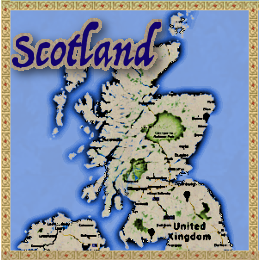
Areas of Interest in the Border regions
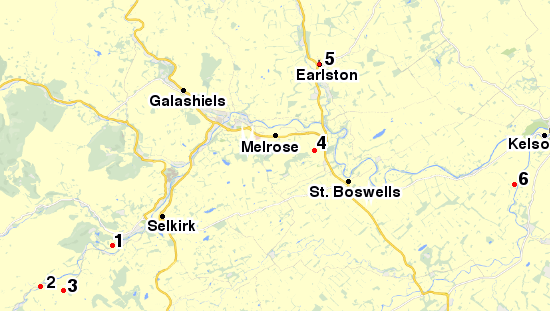
- Carterhaugh - setting for Tam Lin (see below)
- Ettrick Bridge - possible meeting place with faerie troop
- Huntly Bank - one meeting place of Thomas the Rhymer and the faerie Queen
- Eildon Hills - one meeting place of Thomas the Rhymer and the faerie Queen
- Ercledoune (now Earlston) - origin of the seer Thomas of Erceldoune (Thomas the Rhymer)
- Roxburgh - family name cited by Tam Lin in some versions
Carterhaugh and Tam Lin
- From MINSTRELSY OF THE SCOTTISH BORDER By Sir Walter ScottCarterhaugh is a plain, at the conflux of the Ettrick and Yarrow, in Selkirkshire, about a mile above Selkirk and two miles below Newark Castle ; a romantic ruin which overhangs the Yarrow, and which is said to have been the habitation of our heroine's father, though others place his residence in the tower of Oakwood. The peasants point out upon the plain, those electrical rings which vulgar credulity supposes to be traces of the Fairy revels. Here, they say, were placed the stands of milk, and of water, in which Tamlane was dipped in order to effect the disenchantment ; and upon these spots, according to their mode of expressing themselves, the grass will never grow. Miles Cross (perhaps a corruption of Mary's Cross), where fair Janet waited the arrival of the Fairy train, is said to have stood near the Duke of Buccleuch's seat of Bowhill, about half a mile from Carterhaugh. In no part of Scotland, indeed, has the belief in Fairies maintained its ground with more pertinacity than in Selkirkshire.
(Scott had some more direct connections to Carterhaugh. See also: history of Carterhaugh under the Tam Lin and Families of Scotland section.)
The woods in which Tam Lin lives is given as Carterhaugh in many versions of the ballad. Carterhaugh is a genuine location, a tract of woods on the pennisula of land by the meeting of the Ettrick and Yarrow rivers in Selkirk, in Selkirkshire. This is the border region of Scotland. Many of the other locations given in the tale of Tam Lin have counterparts in the same region.
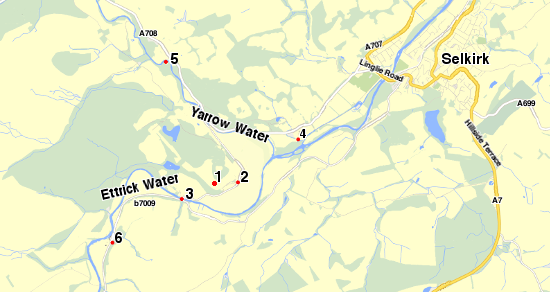
- Carterhaugh Woods - Where Janet meets Tam Lin
- Tamlane's Well - Where Janet throws Tam Lin during his transformation
- Carterhaugh bridge - possible meeting place with faerie troop
- Old Mill (bridge location unknown)
- Newark Castle (possible location of "her father's hall")
- Aikwood (Formerly Oakwood) tower (possible location of "her father's hall")
Today, the Ettrick and Yarrow river regions still have restricted access, although this has more to do with property rights and fishing than fear of any guardians therein.
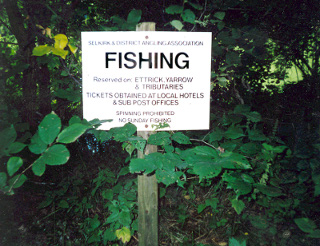
A sign from Carterhaugh woods. It reads:
SELKIRK & DISTRICT ANGLING ASSOCIATION
FISHING
Reserved on: ETTRICK, YARROW
& TRIBUTARIES
TICKETS OBTAINED AT LOCAL HOTELS
& SUB POST OFFICES
SPINNING PROHIBITED
NO SUNDAY FISHING
The area was once home to Sir Walter Scott, and his works are still much beloved in the area. His book, Minstrelsy of the Scottish Border, recorded the local songs and stories of the area, including a version of Tam Lin. A statue to Sir Walter Scott stands in the town square not far from Carterhaugh woods. It is possibly, given the accusation that Scott liked to 'enhance' the ties between folklore and history, that some of the ties between the tale and his region were created or at least exagerated by him, but it can also be hoped that he merely highlighted the tale because of the existing local love of it. For all of the woods named in versions of Tam Lin, Carterhaugh is one of the few that has a true location (Charteris hall may also exist, in so much as the Charteris family owned land, but the location of their woods is unknown to me), and the recording of the tale predates Scott by a long way.
The town itself doesn't have much in the way of tourist industry aimed at Tam Lin fans. A few small tours stop by Tam Lin's well, but the area is not well marked, and can be easily missed as one drives by the area. I have no information on who put up the well, but I'd gamble that it was a more recent creation for the benefit of tourists. While Scotland does have an extensive series of holy wells this one doesn't appear large enough to safely throw and submerge a grown man in. More importantly, the "Old Mill Bridge" marked on the map is nearly fifteen km distant, Carterhaugh Bridge is nearly eight, and so if one assumes one of these two bridges is the one mentioned in many versions of the tale, that would require a good bit of running for Janet to do before she can drop the burning brand of iron.
TamLane's Well
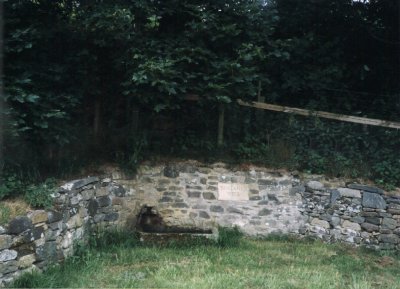
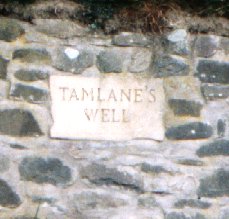
The plaque at the well, reading: TAMLANE'S WELL
In his book Minstrelsy of The Scottish Border, Scott claims that the area around the well was said to have had fairy rings, circles of chalk etched into the ground where grass would not grow (The term is sometimes also applied to circles of wild mushrooms, which has interesting implications given the hallucinagenic affect of some wild mushrooms). Many areas of Scotland have vast chalk deposits in the soil, and once the topsoil has been scraped away, it will take a very long time before the chalk is covered over again. Scott notes the location of Newark Castle as a local favorite for claims of the heroine's father's home, but he himself favours Oakwood tower. Oakwood tower (number 6 on the map above) was recently renamed Aikwood tower, and is the family home of the Steel family (my thanks to Alistair Pattullo for passing on this information).
For more information on Selkirk and Carterhaugh, try the Selkirk Website.
or The Faerie Folklorist site.